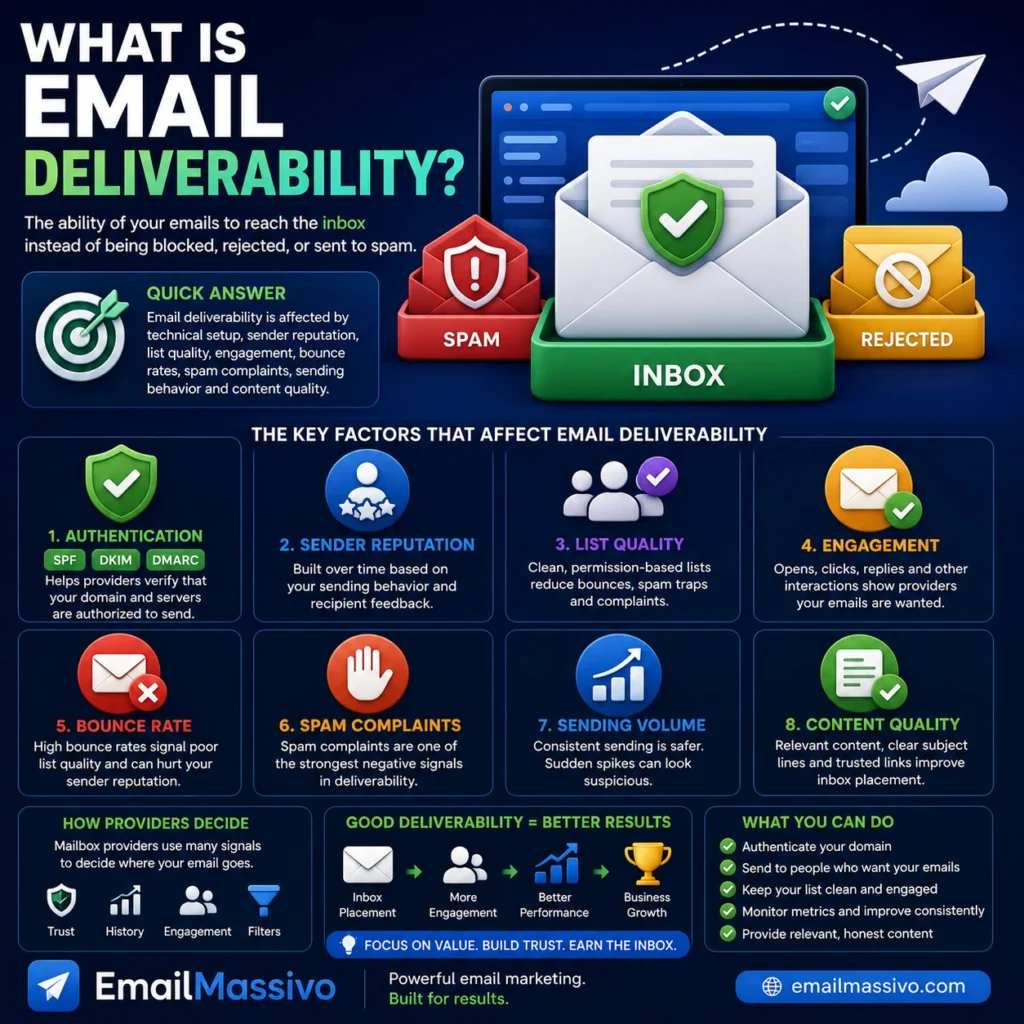
Email deliverability is the ability of your emails to reach recipients’ inboxes instead of being blocked, rejected, or sent to the spam folder.
For email marketing, deliverability is one of the most important parts of campaign performance. A campaign can be well designed, well written, and technically sent, but if it does not reach the inbox, it cannot generate opens, clicks, replies, leads, or sales.
Deliverability is not controlled by one single setting. It depends on several factors working together: domain authentication, sender reputation, list quality, recipient engagement, bounce rates, spam complaints, sending volume, and content quality.
Quick answer
Email deliverability is the ability of an email message to successfully reach the inbox. It is affected by technical setup, sender reputation, recipient engagement, contact list quality, spam complaints, bounce rates, sending behavior, and email content.
Good deliverability means mailbox providers can trust the sender, the domain, the sending infrastructure, and the relationship between the sender and the recipient.
What is email deliverability?
Email deliverability describes whether your emails reach the inbox after being sent.
It is not the same as simply sending an email. A message can be sent from your platform, accepted by a receiving server, and still land in the spam folder. Deliverability focuses on the final placement of the message: inbox, spam, promotions, junk, quarantine, or rejection.
In email marketing, deliverability matters because campaigns depend on visibility. If subscribers do not see your message, the campaign cannot perform.
Email deliverability vs email delivery
Email delivery and email deliverability are related, but they are not the same.
| Term | Meaning |
|---|---|
| Email delivery | The message was accepted by the recipient’s mail server. |
| Email deliverability | The message reached the inbox or another visible placement where the recipient can see it. |
Delivery answers the question: “Was the email accepted?”
Deliverability answers the question: “Where did the email land?”
A campaign may have a high delivery rate but still have poor deliverability if many messages go to spam.
Why email deliverability matters
Email deliverability affects almost every email marketing metric.
If your emails do not reach the inbox, fewer people will open them. This leads to fewer clicks and lower engagement. As engagement drops, mailbox providers may consider future campaigns less relevant.
Poor deliverability can create a negative cycle:
- Emails go to spam.
- Recipients do not see them.
- Engagement drops.
- Sender reputation weakens.
- More future emails go to spam.
Strong deliverability helps protect campaign performance, brand trust, and long-term sender reputation.
Key factors that affect email deliverability
Email deliverability is based on many signals. Some are technical, some are behavioral, and some are related to the quality of your audience.
Email deliverability factors at a glance
| Factor | What it means | Why it matters |
|---|---|---|
| Domain authentication | SPF, DKIM, and DMARC are configured correctly. | Helps mailbox providers verify sender identity. |
| Sender reputation | Trust level of your domain and sending infrastructure. | Affects whether providers accept and trust your messages. |
| List quality | Contacts are valid, active, and permission-based. | Reduces bounces, complaints, and low engagement. |
| Engagement | Recipients open, click, reply, or interact with emails. | Shows providers that your messages are wanted. |
| Bounce rate | Percentage of emails that cannot be delivered. | High bounce rates suggest poor list quality. |
| Spam complaints | Recipients mark your emails as spam or junk. | One of the strongest negative deliverability signals. |
| Sending volume | How many emails you send and how quickly volume changes. | Sudden spikes can look suspicious. |
| Content quality | Subject line, links, formatting, images, and message relevance. | Risky content can increase spam placement. |
1. Domain authentication
Domain authentication helps mailbox providers confirm that your emails are really authorized to come from your domain.
The main authentication mechanisms are SPF, DKIM, and DMARC.
SPF defines which servers can send email for your domain. DKIM adds a digital signature to outgoing messages. DMARC tells mailbox providers what to do when authentication checks fail.
Authentication does not guarantee inbox placement, but without it your campaigns start with a weaker trust profile.
If your emails are going to spam, authentication is one of the first things to check.
2. Sender reputation
Sender reputation is the trust profile associated with your sending domain, IP address, or both.
Mailbox providers build this reputation over time by looking at your sending behavior and recipient reactions.
Positive signals include consistent sending, low bounce rates, low complaint rates, clean lists, and good engagement.
Negative signals include spam complaints, invalid addresses, low engagement, sudden volume spikes, and sending to contacts who did not give permission.
A strong sender reputation improves your chances of reaching the inbox. A weak reputation can send even legitimate campaigns to spam.
3. List quality
A clean, permission-based email list is essential for deliverability.
Poor list quality can lead to invalid addresses, abandoned inboxes, spam traps, low engagement, and more complaints. These signals can damage sender reputation and reduce inbox placement.
A large list is not automatically a strong list. A smaller list of engaged contacts is often more valuable than a large list full of inactive or unverified addresses.
Good list quality means:
- contacts gave permission;
- invalid addresses are removed;
- hard bounces are not contacted again;
- inactive contacts are segmented;
- old lists are reviewed before sending;
- purchased or scraped lists are avoided.
4. Recipient engagement
Mailbox providers pay attention to how recipients interact with email.
Engagement signals can include opens, clicks, replies, reading behavior, moving messages to folders, deleting without opening, and marking messages as spam.
If recipients regularly ignore your emails, mailbox providers may treat future messages as less relevant. If recipients interact positively, your sender reputation can improve over time.
To support engagement, campaigns should be relevant, segmented, and expected by the audience.
5. Bounce rate
A bounce happens when an email cannot be delivered.
There are two common types:
- hard bounce: a permanent delivery failure, usually because the address is invalid or does not exist;
- soft bounce: a temporary failure, such as a full inbox or temporary server issue.
A high bounce rate can hurt deliverability because it suggests that the list is outdated, poorly collected, or not maintained.
Hard bounces should be removed. Repeated soft bounces should also be reviewed.
6. Spam complaints
A spam complaint happens when a recipient marks your email as spam or junk.
This is one of the strongest negative signals in email deliverability.
Complaints often happen when recipients do not recognize the sender, did not subscribe, receive too many emails, cannot easily unsubscribe, or feel misled by the subject line.
To reduce complaints, send only to people who expect your emails, use a recognizable sender name, make unsubscribe easy, and avoid misleading content.
7. Sending volume and consistency
Mailbox providers look at sending patterns.
A sudden increase in volume can look suspicious, especially if the domain is new, inactive, or has limited sending history.
For example, a domain that usually sends a few hundred emails and suddenly sends tens of thousands may trigger filtering.
Gradual volume growth is safer. Start with engaged contacts, monitor metrics, and increase volume only when performance is healthy.
8. Content quality
Email content can also affect deliverability.
Spam filters look at subject lines, links, images, formatting, attachments, sender identity, and message structure.
Common content problems include:
- misleading subject lines;
- excessive capitalization;
- too many exclamation marks;
- suspicious links;
- link shorteners;
- image-only messages;
- large attachments;
- unclear sender identity;
- hidden unsubscribe links.
Good content should be clear, relevant, honest, and aligned with what the recipient expected to receive.
How mailbox providers decide where emails go
Mailbox providers use many signals to decide whether an email should reach the inbox, go to spam, or be rejected.
They may evaluate:
- whether the domain is authenticated;
- whether the sender has a good reputation;
- whether similar messages were accepted or ignored before;
- whether recipients engage with the sender;
- whether the list appears clean;
- whether the content looks trustworthy;
- whether users mark similar messages as spam.
This decision is not based on one factor. It is based on a trust profile built from technical, behavioral, and historical signals.
How to measure email deliverability
Deliverability is not always visible through one simple metric, but several indicators can help identify problems.
Useful metrics include:
- delivery rate;
- bounce rate;
- open rate;
- click rate;
- unsubscribe rate;
- spam complaint rate;
- inbox placement tests;
- domain reputation signals;
- engagement by mailbox provider.
A drop in open rate may suggest inbox placement issues, but it is not enough by itself. Instead, review it together with bounces, complaints, list quality, and sending changes.
Common deliverability problems
Common email deliverability problems include:
- emails going to spam;
- missing SPF, DKIM, or DMARC records;
- high bounce rates;
- poor sender reputation;
- low engagement;
- too many spam complaints;
- sending to old or purchased lists;
- sudden campaign volume increases;
- inconsistent sender identity;
- unclear unsubscribe process.
Most deliverability problems result from several factors working together, not from one isolated mistake.
How email marketing platforms fit into deliverability
An email marketing platform can help businesses create campaigns, manage contacts, send messages, and monitor performance.
A service such as EmailMassivo can support the campaign workflow, but deliverability also depends on the sender’s domain setup, list quality, content, and sending behavior.
The platform is one part of the sending system. The sender still needs an authenticated domain, permission-based contacts, relevant campaigns, and consistent monitoring.
The strongest results come when the platform and the sender’s practices work together.
Practical deliverability checklist
Before sending a campaign, check the following:
- Authenticate your sending domain with SPF, DKIM, and DMARC.
- Use a recognizable sender name.
- Keep a permission-based contact list.
- Remove hard bounces.
- Segment inactive contacts.
- Make sure your subject line matches the message content.
- Include a clear unsubscribe option.
- Point your links to trusted domains.
If several of these points are weak, deliverability risk is higher.
FAQ
Email deliverability describes how successfully your emails reach the recipient’s inbox.
Delivery means the receiving mail server accepted the message. Deliverability means the message reached the inbox or another visible placement where the recipient can see it.
No. SPF, DKIM, and DMARC help mailbox providers verify the sender, but inbox placement also depends on reputation, engagement, list quality, complaints, bounces, and content.
A receiving server can accept an email but still send it to spam. This can happen because of poor reputation, low engagement, suspicious content, weak authentication, or poor list quality.
A good strategy combines domain authentication, clean lists, relevant content, gradual sending volume, low complaint rates, low bounce rates, and regular performance monitoring.
A platform can help with campaign sending, contact management, reporting, and technical setup, but it cannot fully fix poor list quality, bad content, lack of consent, or weak sender reputation.
Start with SPF, DKIM, and DMARC. Then review bounce rate, spam complaints, sender reputation, list quality, engagement, content, and recent volume changes.
Key takeaways
Email deliverability is the ability of your emails to reach the inbox, not just to be sent.
It depends on technical setup, sender reputation, list quality, engagement, bounce rate, spam complaints, sending consistency, and content quality.
Good deliverability is not a one-time configuration. It is an ongoing process that combines authentication, responsible sending, clean contacts, relevant campaigns, and careful metric monitoring.
For email marketing, deliverability is the foundation of performance. If your emails do not reach the inbox, the rest of the campaign cannot work properly.